Understanding Real Estate in a Downturn
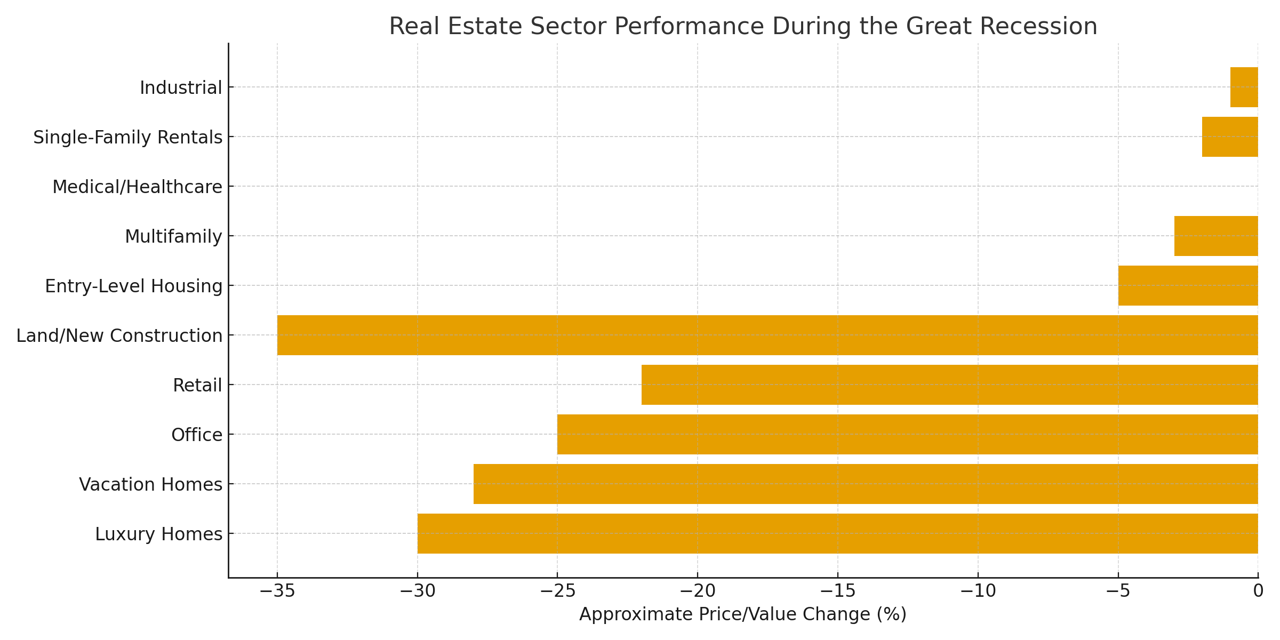
Economic cycles rise and fall, but real estate never moves in the same direction across all sectors. Looking back at the Great Recession (2007–2009) gives buyers, sellers, and investors a helpful roadmap for understanding how different property types behave when the economy slows.
These patterns don’t repeat perfectly—but they rhyme. And knowing those rhythms helps you make decisions with confidence, no matter what the headlines say.
🟥 Real Estate Sectors Hit the Hardest in the Last Recession
1. Luxury Residential Homes
Luxury homes tend to feel the shift early because they rely heavily on investment income, strong lending, and discretionary purchasing power.
During the last recession, high-end properties experienced:
Steep price drops (often 20–30%+)
Longer days on market
A large decline in qualified buyers
When buyers pull back, luxury is the first to slow.
2. Vacation Homes & Second Properties
Second homes are typically the first thing buyers pause on—and the first thing sellers liquidate.
This sector saw:
Significant drops in demand
More listings from owners trying to free up cash
Overall price softening due to shifting priorities
Optional buying tends to disappear quickly in a recession.
3. Commercial Office Buildings
With business closures and layoffs, office properties faced:
Sharp increases in vacancy
Expanded sublease inventory
Declining rental rates
This sector also had one of the slowest recoveries due to structural workplace changes.
4. Retail Real Estate
Shopping centers and malls were heavily affected by:
Reduced consumer spending
Multiple retail bankruptcies
Long-term shifts toward e-commerce
Retail continues to evolve as shopping habits change.
5. Land & New Construction
Financing for land and new builds became nearly impossible during the recession.
As a result:
Builders paused projects
Developments stalled
Land values declined sharply
Because land doesn’t produce cash flow, it becomes highly risky in a tight credit environment.
🟩 Real Estate Sectors That Performed the Best
1. Entry-Level & Affordable Housing
This segment remained the strongest because no matter the economy, people need a place to live.
Affordable homes benefited from:
First-time buyer demand
FHA and government-backed financing
Limited inventory
This is generally the most recession-resistant segment of residential real estate.
2. Multifamily Apartments
As more people rented instead of buying, multifamily properties remained stable.
Benefits included:
Strong occupancy rates
Consistent rent performance
High investor demand for reliable cash flow
Multifamily proved to be one of the safest long-term investments.
3. Medical/Healthcare Real Estate
Healthcare needs don’t disappear during economic weakness.
Medical office properties showed:
Steady demand
Long leases
Strong tenant retention
This sector often outperforms traditional commercial property.
4. Single-Family Rentals (SFRs)
With tighter budgets and lending restrictions, rental demand rose significantly.
SFRs benefited from:
Predictable cash flow
Rising occupancy
Lower turnover compared to apartments
Institutional investors expanded aggressively into this sector after 2010 for a reason.
5. Industrial & Logistics Real Estate
Driven by the rise of e-commerce, industrial real estate showed resilience with:
Steady demand from logistics companies
Lower vacancy rates
Faster recovery post-recession
Industrial remains one of the most stable commercial sectors today.
⭐ Why This Matters in Today’s Economy
While today’s economy isn’t identical to 2008, several important parallels exist:
✔ Rising interest rates
✔ Tighter lending
✔ Consumers becoming more selective
✔ Slower economic growth
✔ Shifts in work, retail, and investment behavior
Understanding how each real estate sector behaved last time helps you anticipate what’s likely to stay strong now—and what may soften.
1. The Sectors That Held Strong Before Are Still the Most Resilient
Entry-level homes, rentals, and multifamily continue to show strong demand today because:
Households still need affordable living
Renting becomes more attractive when rates rise
Investors lean toward stable, income-producing assets
This means if you’re buying or selling in these segments, you’re operating in historically strong territory.
2. Luxury and Discretionary Purchases Still React the Fastest
As financial markets fluctuate and interest rates climb:
Luxury buyers take longer to make decisions
High-end days-on-market extend
Pricing strategy becomes more important
This doesn’t mean luxury doesn’t sell—it just requires smarter positioning and exceptional marketing.
3. Commercial Real Estate Is in Another Transformation
Office and retail are still evolving due to remote work and online shopping.
History shows us:
These sectors are slower to recover
Strategic tenants matter more than ever
Location and long-term use cases are key
Investors have become much more selective—and for good reason.
4. Real Estate Remains One of the Safest Hard Assets
Even during uncertainty, real estate continues to offer:
Tangible value
Long-term appreciation
Protection against inflation
Income-producing potential
The last recession proved that well-chosen real estate outperforms many other asset classes in unstable times.
What This Means for Buyers, Sellers, and Investors Today
Understanding past performance helps today’s homeowners feel confident—not fearful.
Thinking about selling? Pricing strategy and presentation matter more in slower segments.
Thinking about buying? Entry-level and rental-friendly properties remain the strongest value plays.
Thinking about investing? Multifamily, rentals, and essential-service properties continue to show resilience.
The good news: knowledge reduces uncertainty, and the right strategy wins in any economy.
Your Trusted Guides in Any Market
No matter where we are in the economic cycle, having an advisor who understands market patterns makes all the difference. Ehrin and Caleb Fairey bring the insight, preparation, and strategy needed to help homeowners and investors thrive—whether the market is rising, shifting, or leveling out.
If you're buying or selling, we're here to guide you with clarity and care every step of the way.