Why Data Centers Are Locating in Columbia County, Georgia
What it means for residents, taxes, infrastructure, and the local economy
Over the past year, few topics have generated as much discussion in the CSRA as data centers. From packed public meetings to heated social media debates, many residents are asking the same question: why Columbia County?
The short answer is infrastructure, economics, and national priorities. The longer answer—and the one that matters most to residents—includes tax relief, new ordinances, and long-term planning. Let’s break it down in a clear, easy-to-read way.
National and State-Level Forces Driving Data Center Growth
Data centers aren’t appearing randomly. They are being pulled to very specific places for very specific reasons.
🇺🇸 National Security and Data Demand
The United States now consumes roughly 400,000 terabytes of data every day.
Federal policy increasingly prioritizes keeping sensitive data stored within U.S. borders for national security reasons.
That demand requires massive, secure, and reliable facilities—and a lot of them.
⚡ Georgia’s Competitive Advantage
Georgia offers sales tax exemptions on data center equipment, a major incentive for developers.
Reliable and expandable power infrastructure—supported by Georgia Power—makes large-scale projects feasible.
Compared to other states, Georgia provides a faster, more predictable development environment.
Why Columbia County Stands Out
Not every Georgia county can support a modern data center campus. Columbia County checks several rare boxes.
Existing Infrastructure Matters
Large high-voltage power transmission lines already run through specific tracts of land.
Developers actively seek large, contiguous parcels—something Columbia County has in limited but valuable supply.
These factors dramatically reduce development risk and cost.
The White Oak Site: The Catalyst
The county initially promoted the White Oak site, with about 200 acres remaining to develop.
Officials intentionally turned away heavier industrial uses in favor of cleaner, low-impact tenants.
Once developers recognized the scale of available land and power access, interest rapidly expanded.
Ultimately, developers gained control of approximately 1,600 acres across multiple sites.
Land Deals and Explosive Property Values
The financial impact of data center interest has been swift—and staggering.
The county earned $50 million through the purchase and resale of land at White Oak.
White Oak parcel experienced dramatic value increases—from $9 million to $450 million in roughly one year after changing hands numerous times.
After White Oak, the other projects became developer-driven, with the county acting only as a regulator, not a partner.
Economic Impact: Tax Relief and Revenue Growth
This is where the conversation directly affects homeowners.
Property Tax Relief for Residents
County leaders have openly stated their goal: eliminate homestead property tax.
Data centers generate enormous property and sales tax revenue, particularly through power consumption.
Annual county property tax revenue could grow from $42 million to $240 million as projects build out.
Scale of Investment
Projected data center investment: $200–$300 billion.
For comparison, the entire current county tax digest is about $8.5 billion.
Even partial completion dramatically shifts the county’s financial landscape.
Schools and Services
Discussions with the Board of Education are underway about potential school tax relief.
Revenue also supports:
Road repaving
Water and sewer upgrades
Public safety and infrastructure improvements
Legislative changes are required, and officials estimate 2–3 years before full implementation, depending on construction timelines and state approval.
Ordinances, Protections, and Quality-of-Life Safeguards
One of the biggest concerns from residents has been regulation. Early on, no data center zoning existed—so the county acted quickly.
The Data Center Ordinance (DC Ordinance)
After studying best practices (including Loudoun County, Virginia), Columbia County adopted one of the strictest data center ordinances in the region, including:
Up to 500-foot buffers from residential property
Downward-facing lighting to reduce light pollution
No private well drilling (county water only)
Noise limits and infrastructure requirements
Mitigation plans if a data center becomes obsolete
Mandatory site-specific conditions added during rezoning if needed
Water Use Reality
Modern data centers use closed-loop cooling systems.
Water is reused internally, with no impact on aquifers or nearby wells.
County officials regularly address this concern directly in public meetings.
Political Dynamics and Public Perception
Opposition exists, and not all of it is rooted in the same concerns.
Some resistance is political.
Some is driven by misinformation amplified by social media algorithms.
Officials emphasize that no project bypasses the rezoning process, and no deal is finalized without public hearings.
Examples from nearby and comparable regions—such as Meta’s investment in Aiken County and large campuses in Northern Virginia—show that strong guardrails matter, and Columbia County has chosen to implement them early.
Current and Proposed Data Center Sites
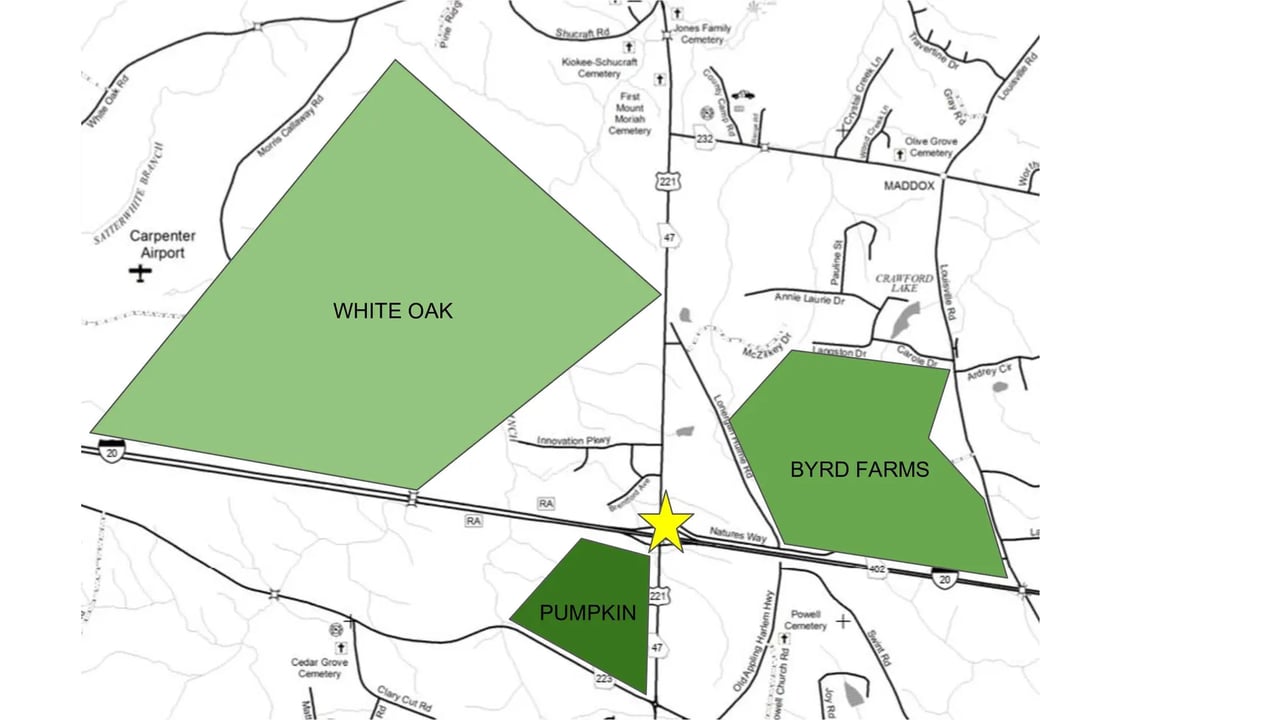
Three main sites are under consideration:
White Oak – Mega-site, most advanced, county-initiated
Prather / Green Point – Smaller, speculative, developer-driven
Byrd – Most challenging due to residential proximity
Each project requires:
Millions spent on power studies and bonds before rezoning approval
Significant long-term commitments from developers
A typical data center employs 30–50 permanent workers per building, while construction supports hundreds of jobs and extensive local business activity.
What Happens Next: Practical Action Steps
County leadership has outlined several next moves:
Continue public information meetings and transparent updates
Finalize and share the Data Center Ordinance widely
Coordinate with the Board of Education on school tax strategy
Encourage local businesses to prepare for construction and service bids
Conduct ongoing road, water, and sewer impact assessments
Actively incorporate reasonable citizen concerns into rezoning conditions
The Big Picture
Data centers are coming to Columbia County because the county is prepared—not because it is careless. The combination of infrastructure, ordinance protections, and unprecedented revenue potential places the community at a crossroads.
Handled responsibly, these projects could mean:
Lower property taxes
Stronger infrastructure
Long-term financial stability
Minimal daily impact on residents
The conversation is far from over—but the facts matter. Staying informed, engaged, and grounded in real data will shape how this opportunity ultimately benefits the community we call home.